Saturday Snippet: A poem

This week’s Saturday Snippet is from a poem called “For and Against the Environment”, by D. M. Black, from a favorite anthology, “The Oxford Book of Garden Verse.”

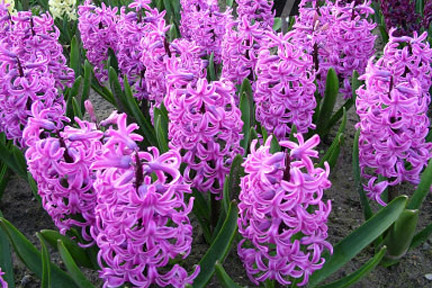
I have come out to smell the hyacinths which again in this

North London garden

Have performed a wonderful feat of chemistry and hauled

that delectable perfume

out of the blackish confection of clay and potsherds which

feebly responds when I name it flower-bed;

and so wet was the Spring that I clipped the grass with

shears, to prevent the mower sliding in mud,

and my attempt to dig the beds to enhance their fertility

foundered caked with clods.


Saturday Snippet: The Scented Garden

If any of you also read my blog Serenity Now, you know that I enjoy fragrance and perfume, and I post about scents on most Fridays: Fragrance Fridays. Today, Saturday Snippets and Fragrance Fridays come together, with an excerpt from Rosemary Verey’s The Scented Garden.

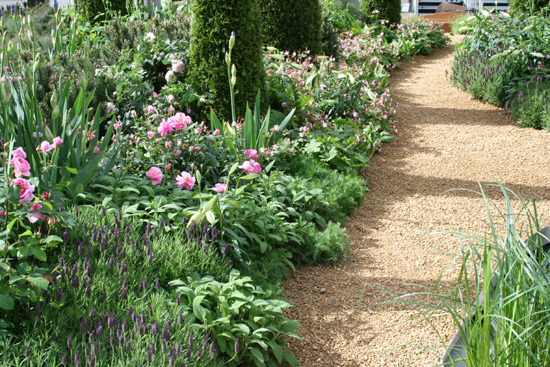
My ideal scented garden is surrounded by a wall or hedge, for scent is never still, indeed it is best when carried on the breeze, and a wall will help to contain it. If you have no wall then put the fragrant plants close to the house, so that when you walk outside you will easily catch their scent. Plant narrow beds and make many paths, to allow you to walk close to the scented leaves and brush against and squeeze them. Make low hedges of lavender and southern-wood. Have some raised beds for flowers which are fast with their scent so they may be enjoyed without bending low. Plants that release their perfume easily should be planted so the prevailing wind will bring the scent to you.

Photo: www.shootgardening.co.uk

Owl Moon

We have lived in our house for 23 years. It is in the middle of a city, though our neighborhood is park-like, and over 100 years old. We have tall trees and small lots, but my garden and those of my neighbors are a decent size, ranging from one quarter of an acre to a full acre.

Tonight, for the first time in those 23 years, we distinctly heard an owl calling. More than once — in fact, for several minutes. I think it was a barred owl; it had the distinctive rhythm sometimes described as “Who cooks for you? Who cooks for you?”. And it sounded just like my father.

My father was a bird lover and bird-watcher. During my childhood, he developed a fascination with owls of all kinds, and he learned how to call them from the elevated deck on the back of our house, which faced several acres of New England woods. Hoo hoo hoo-hoo, he would call; and the owls would call back to him.

I taught my youngest child this trick some years ago, when we spent a week in Yorkshire at a wonderful, isolated location surrounded by woods on two sides and looking out over the moors on another. I cherish the memories of playing on a swingset with my little boy, stopping to listen to owls calling to each other in the woods, and teaching him to call back to them from the old walled garden, across an ancient ha-ha.

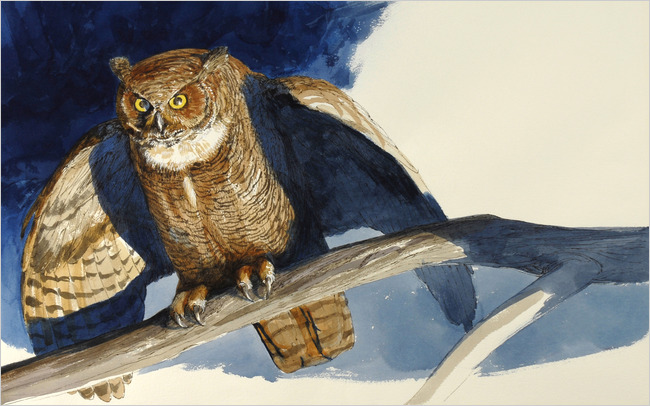
Although my father never took me out into the woods at night to call owls, I used to read the book “Owl Moon” by Jane Yolen to my children. So in honor of tonight’s owl, here is a video snippet from that lovely book: Owl Moon.

Illustrations by John Schoenherr.
Saturday Snippet: The Lily of the Valley Fairy

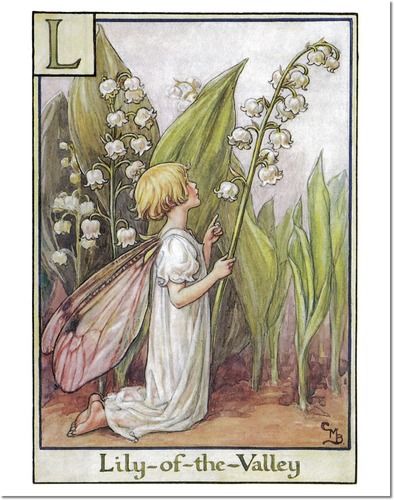
I planted twenty lily of the valley pips today, so this weekend’s Saturday Snippet is from a favorite book series: Cicely Mary Barker’s Flower Fairies. Lilies of the valley are some of my favorite flowers, and I love their fragrance too.

Gentle fairies, hush your singing;
Can you hear my white bells ringing,
Ringing as from far away?
Who can tell me what they say?

Little snowy bells out-springing
From the stem and softly ringing—
Tell they of a country where
Everything is good and fair?

Lovely, lovely things for L?
Lilac, Lavender as well;
And, more sweet than rhyming tells,
Lily-of-the-Valley’s bells.

And this was one of my favorite songs to sing as a round with my children when they were little:

White coral bells upon a slender stalk
Lilies of the valley line my garden walk.
Oh, don’t you wish that you could hear them ring?
That will happen only when the fairies sing.

Cicely Mary Barker Lily of the Valley Fairy

Illustration and poem: Copyright Estate of Cicely Mary Barker.

Hellebore Appreciation Society – at Ashwood Nurseries Open Day

Y’all. These photos have to be seen to be believed. Thank you, Martin! I want every single one of these hellebores.

The Teddington Gardener's avatarThe Teddington Gardener

MBO_4668MBO_4678

Ashwood Nurseries are world-famous for their Hellebores and the range of hybrids they create is quite remarkable for their breadth and beauty. My timing for this visit was perfect as I was travelling down from Manchester to London, and this was an excellent stopover, just to the west of Wolverhampton (for them, close to a big population base but in quite secluded rural location). And as I knew, there was an Open Day, with behind the scenes tours around the glasshouses where the breeding program happens. Marvellous.

MBO_4684

The colours range from pure white to deep plum and slate, passing through pale lemons, deeper golds, pinks, peaches, ruby and claret red, jade greens – with spots and dots, stripes, blotches and contrasting veins, picotee edging (a fine line at the edge of the tepals) while the inner ring of nectaries (the petals, really) provide further interest, in green, gold, purple, red…

View original post 244 more words

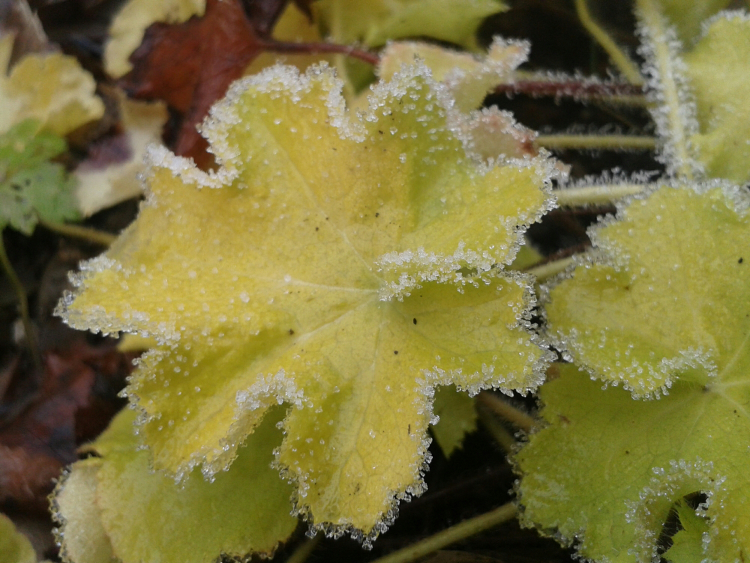
Heuchera Lemon Chiffon

This post has inspired me! Last year we planted a small grove of different Japanese maples, in a front side yard under a very large, old oak, in high shade. It is bordered by a curving pathway that leads from the sidewalk to our front steps, across the front of our old house, and that pathway is lined by pink azaleas on both side. I have been wracking my brains to figure out what, if anything, to plant under the small Japanese maples.

Aha! Heucheras! I have become fascinated by the many pretty varieties at the garden centers and in the catalogs, but I’ve held off on buying many of them until I could decide where I might place them. I think their many colors will work nicely with the foliage of the Japanese maples, and this site is on a slight slope which will help them with drainage. They will be close enough to a pathway so their details can be seen. Like the Japanese maples, their foliage colors change over the seasons, so I think it will be a dynamic display. Thank you, Tamara at My Botanical Garden!

Does anyone have any experience with heucheras as an underplanting that you’d like to share?

Source: Heuchera Lemon Chiffon

Saturday Snippet: Winter Gardens and Conservatories

In honor of this January weekend’s blizzards and storms, and feet of snow in much of the Northeastern United States, as well as the new season of Downton Abbey airing this month, this week’s Saturday Snippet is from “The Head Gardeners; Forgotten Heroes of Agriculture”, by Toby Musgrave.

Ornate conservatories or winter gardens were an adjunct of any garden that claimed to be of note. They were sometimes attached to the house or detached and set in the pleasure grounds. These great glass structures were home to many exotic and tender new arrivals brought from jungles and tropical regions across the world. Indeed, be they tendder, half-hardy or hardy, the wealth of new plants brought to Britain by the plant hunters excited botanists and garden-owners, and provided head gardeners with a constant onslaught of challenges. These expensive treasures required careful and skilled nurturing to survive. Often in the vanguard of those attempting to cultivate such tricksy rarities, the head gardener had to rely on his experience, a modicum of experimentation and an ability to learn fast.

Photo: RBG Kew.

Saturday Snippet: Bulb

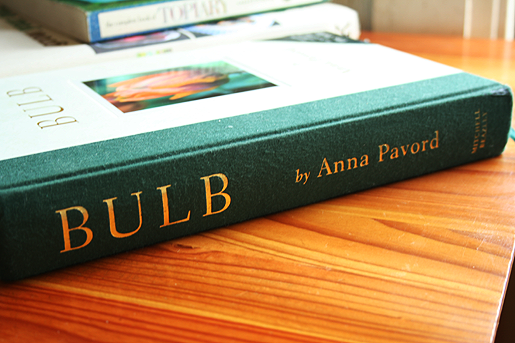
This week, I am quoting an author whose book I do not yet own: Anna Pavord, author of “Tulip” and “Bulb.” I need to own the latter. In middle age, I have realized that I have a few consistent passions toward specific kinds of plants. One of them is the family of bulbs and corms. I think what I love is the gift-like nature of bulbs: they are like little papery packages, hiding wonderful flowers within. I love the surprise aspect of not knowing exactly when their shoots will suddenly appear; and many of my favorite flowers come from bulbs: narcissus, crocus, amaryllis, lilies, etc. Bulbs work on their own timetables.

“At the heart of the whole business is the feeling that when we garden we abandon a timetable constructed around dentists’ appointments, car services and the possible arrival of trains, to plunge headlong into a completely different timetable, an immense and inexorable one entirely outside our control, ruled by the sun, the moon, the seasons.”

Photo: www.chicagonow.com

Saturday Snippet: January

Calensariel at Impromptu Promptlings posted recently about poet W.S. Merwin and encouraged readers to share a favorite. Here’s another, suitable for reading this week especially after all the warm rain we have had lately:

Poem

The poet, translator, and environmental activist W. S. Merwin has become one of the most honored and widely read poets in America and was appointed United States poet laureate in 2010. Today, he lives, writes and gardens in Hawaii, on Maui. His poem “January” evokes a cold wintry night.
— Poetry Foundation

January
By W. S. Merwin

So after weeks of rain
at night the winter stars
that much farther in heaven
without our having seen them
in far light are still forming
the heavy elements
that when the stars are gone
fly up as dust finer
by many times than a hair
and recognize each other
in the dark traveling
at great speed and becoming
our bodies in our time
looking up after rain
in the cold night together